Impact
The design system turned a pivot into a sprint
When the founding team decided to change markets, the modular system I'd built meant 60% of the product could be reused directly — auth, forms, navigation, cards, progress UI. Only the brand, content, and healthcare-specific features needed rebuilding.
Problem
Understanding the Market Challenge
Mindset was conceived as a consumer meditation app in a market dominated by Calm ($2B valuation) and Headspace ($320M funding). We were a self-funded 4-person team with no marketing budget.
Impossible to Compete on Content
Consumer meditation market dominated by well-funded incumbents. Headspace: 70M+ downloads. Calm: 100M+ downloads, $150M annual revenue.
4-Person Team, 3-Month Runway
Self-funded with limited research budget. Couldn't compete on content volume, celebrity partnerships, or marketing spend.
"Better Habit Formation" Wasn't Enough
Users already invested in competitors. Switching costs too high. No unique market position without significant funding.
The Strategic Decision
Why We Pivoted
At week 12, we made the call: stop building for a saturated consumer market and leverage founder expertise for B2B healthcare.
We couldn't win in consumer wellness without a marketing budget. Healthcare workforce wellness made sense — employers pay for it, so there's no individual switching cost, and the market was much less crowded than B2C meditation. The co-founders had 10+ years in healthcare ops, which meant we could sell on expertise rather than spend.
Design System Advantage
Why the Pivot Took 3 Weeks Instead of 4 Months
From the start, Mindset was built on a token-based system — not because I knew we'd pivot, but because it was the right way to build. That decision turned out to matter a lot.
Three-Tier Token Structure
- Primitive tokens — base colors, spacing, typography
- Semantic tokens — brand-primary, surface-secondary
- Component tokens — button-bg-default, input-border-focus
A brand identity swap required changing only the primitive layer — all semantic and component tokens cascaded automatically.
Reused vs. Changed
Reused (60%): Auth flows, forms, navigation, cards, progress UI, multi-tenant architecture — same patterns, same inputs, same structure.
Changed (40%): Brand identity, healthcare content, compliance features, admin-focused reporting.
The Product
Three Interconnected Platforms
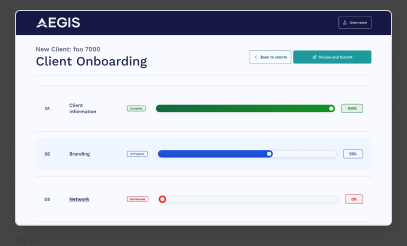
Aegis isn't one tool — it's three platforms built from a shared system, each solving a different stage of client lifecycle.
Operations Hub — Onboarding & Configuration
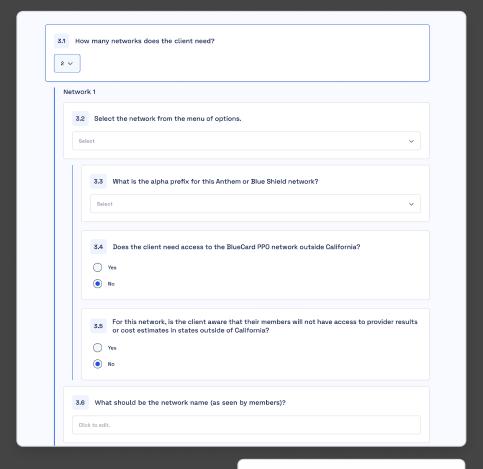
10-section questionnaire replaces email-based requirements gathering. Real-time progress tracking, save-and-resume, and a review workflow that catches errors before implementation begins.
QA Hub — Continuous Data Quality Monitoring
Most platforms validate once at launch. Aegis monitors continuously. 99+ automated reports run 24/7 for 35+ health plan clients — flagging stale records, formatting errors, and regulatory compliance gaps before they reach members.
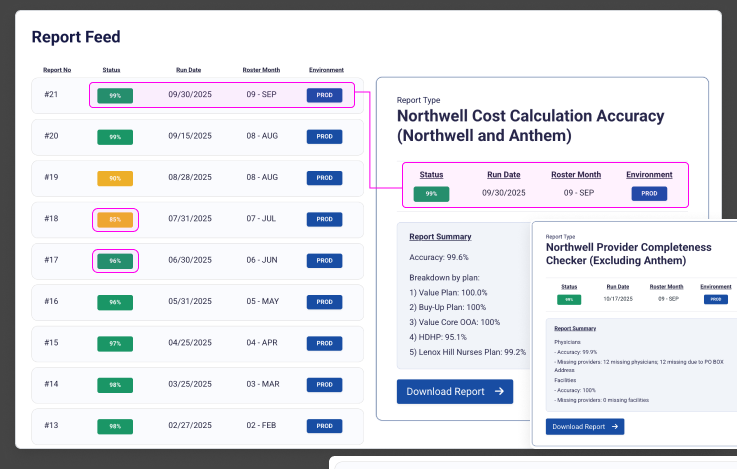
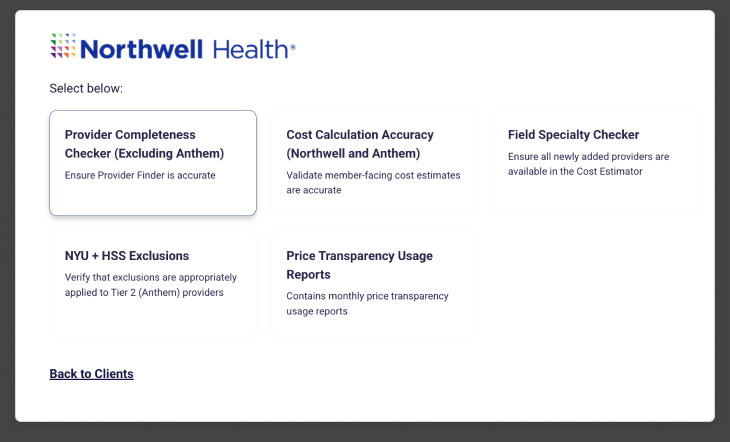
Provider directory data is mission-critical — members depend on it to find care. Physicians move, retire, change specialties. A wrong address means someone shows up to a closed office. A wrong specialty means a misdiagnosis risk. The QA Hub exists because data degrades constantly, and manual checking doesn't scale across 35+ clients.
Design System
Healthcare-First Design Principles
Healthcare is compliance-critical. Every component was designed to WCAG AAA from day one — 7:1 contrast ratios, full keyboard navigation, semantic HTML + ARIA labels, 44x44px touch targets.
7:1 contrast ratios, keyboard nav, screen reader support, 44x44px touch targets. Healthcare = compliance-critical, so AAA wasn't optional.
Large touch targets, high contrast for bright hospital environments, offline-capable patterns. Healthcare workers don't sit at desks.
Multi-organization support, role-based access control, compliance reporting, audit logs. B2B requires organization management from the ground up.
Solution in Context
Real Clients, Real Impact
35+ health plan clients across the country — from New York's largest health system to regional insurers.
Impact & Outcomes
Measuring Success
- 35+ health plan clients on platform
- Millions of members served
- 60% dev-cycle reduction via component reuse
- 3-week pivot (vs. 12-16 week estimate from scratch)
- "Everything is laid out in a super clean and clear way"
- 100% task completion rate with zero drop-off
- Feedback focused on simplicity and workflow clarity
- Avoided 6-12 months in saturated consumer market
- Leveraged founder healthcare expertise as moat
- Entered underserved B2B market with enterprise-scale architecture